




Ask most COMAH sites whether they’re ready for MHHHRA and you’ll get something like “broadly, yes, we’ve got our HAZOPs, our safety report, our risk assessments”. Many are less ready than that answer suggests.
That’s not a criticism of anyone. It’s that the gaps that matter don’t announce themselves. They sit inside work that looks finished, and they only come out when someone actually goes looking. Far better that’s you now than an inspector further down the line. This page is about what to look for. (For what MHHHRA actually is, start with What is MHHHRA?.)
Readiness isn’t a feeling, it’s checkable
“Are we ready?” feels like a judgement call. It isn’t, really. MHHHRA has a clear structure, and readiness is simply whether your work holds up against each stage of it. A thick folder of studies can feel like readiness while hiding real gaps. A leaner site that’s done the right things can be in better shape than it thinks. The only way to know is to check, stage by stage.
The gaps I see most often
Across the sites I work with, the same gaps come up again and again. None are exotic. See how many you can confidently rule out.
Can you show how you got to your scenario list? Producing a list of major accident scenarios is one thing. Evidencing it is another: which studies fed it, what the top-down work added, and that nothing slipped through the join. Without that trail, the list is an assertion rather than proof.
Does your coverage actually cover the site? A full HAZOP folder feels like full coverage, but studies often exist for only part of the plant. The units that get missed tend not to be the obvious ones. They’re the parts that don’t read as “process”: a drum or IBC store, a warehouse, a compressor in an enclosure, the ammonia chiller everyone thinks of as refrigeration.
Did your screening stop at who could be killed? The duty runs to serious danger to people, and that takes in serious injury, not fatality alone. A lot of assessments only ever counted deaths.
Are your numbers really your numbers? Failure rates pulled from generic datasets, dropped in without any link to your actual asset, aren’t telling you about your site. A plain storage tank and one that’s heated, agitated or holding something reactive carry very different risk, and your figures should show it.
Do your LOPA and your risk assessment agree? It’s more common than you’d think for a site’s LOPA to reach one conclusion and its COMAH risk assessment another, for the very same scenario. They’re meant to tell one consistent story.
Has anyone added the scenarios up? Solid analysis of individual scenarios still isn’t assessment. Assessment is the cumulative picture: the total risk to the people actually exposed across everything that could happen. Plenty of sites have the first and have never done the second.
Is anyone watching for change you didn’t make? The change that quietly invalidates your assessment often happens off your plant. A housing development, a school or a new occupied building near your boundary shifts your off-site risk while nothing inside the fence line moves. Most sites have nothing in their management system looking outward for it.
If a few of those gave you pause, that’s normal, and it’s exactly why checking properly is worth the time.
Why these gaps persist
Worth saying plainly: these aren’t failures of effort or competence. They’re almost always down to the underlying studies, standards or management arrangements never being set up for the job MHHHRA now asks of them. A HAZOP run as a general process-safety study, a risk matrix inherited from a corporate template, an MOC process that updates drawings but never routes a change back into the risk assessment: each is reasonable on its own terms, and each quietly leaves a gap. That’s why they’re so common, and why an outside check tends to find things an internal team, close to the work, doesn’t.
When should I start?
Now is easier than later, for a simple reason. Every gap is cheaper to close on your own timetable than under regulatory pressure with a deadline attached. Finding them early turns a potential problem into a manageable plan.
See where your site stands
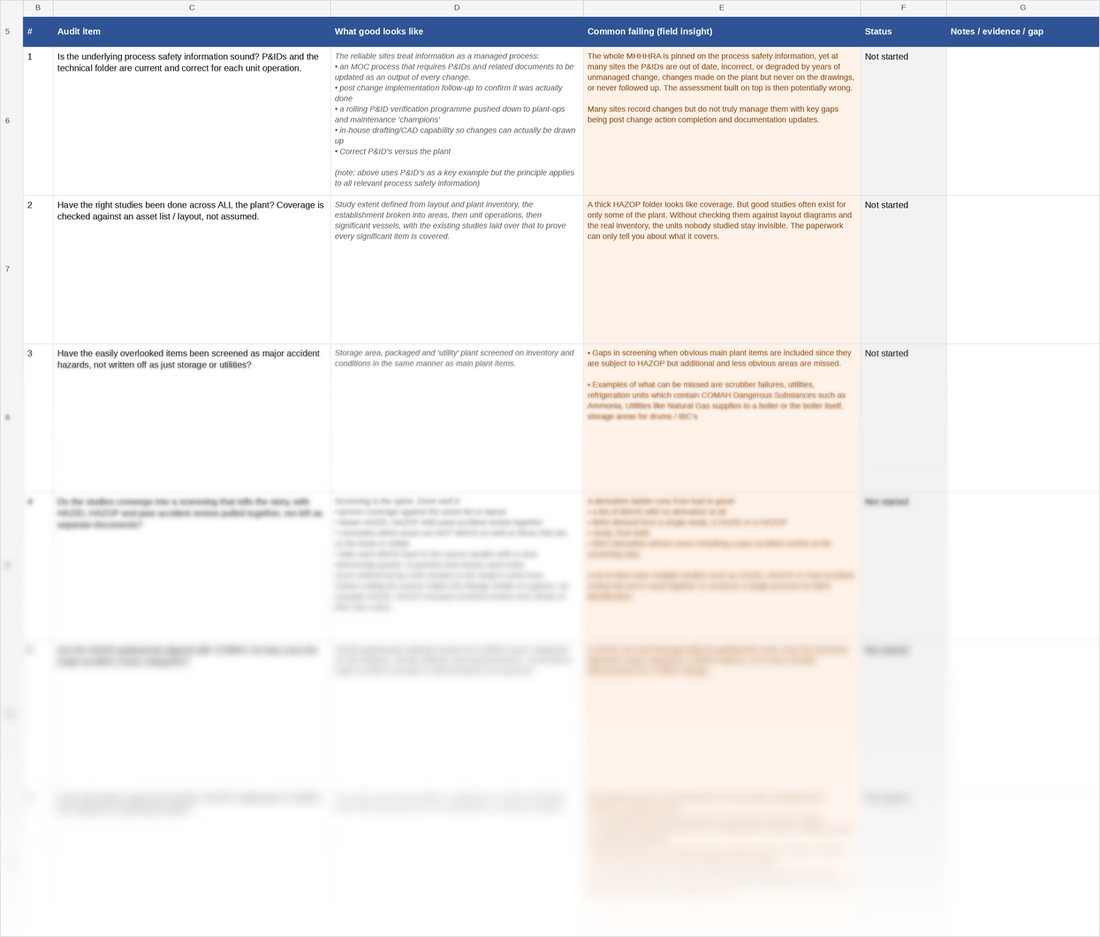
You don’t have to guess where you stand. My free MHHHRA readiness self-assessment lets you check it properly, stage by stage. Here’s what you get:
- A free, downloadable Excel-based gap-analysis tool — simple to use, nothing to install, and yours to keep.
- A question set aligned to the guidance, covering the key areas: identification, analysis, assessment, further measures, and your Safety Management Systems (SMS).
- What “good” looks like for each question, alongside the common issues I see on real sites from my own field experience, so you can spot your gaps fast.